
Overcoming the Bottlenecks in Malawi’s Nature-Based Tourism
“Malawi has the potential to attract significant private investment, create jobs, and generate substantial foreign exchange. To realize this potential, the country will need to leverage its peaceful society, newly discovered mineral deposits, and natural capital, ranging from a favorable climate to the vast Lake Malawi and numerous other tourist attractions. Attracting private investment is critical for Malawi to overcome its development challenges.”
This is part of the abstract from the World Bank publication: Malawi Country Private Sector Diagnostic, June 2026.
The report provides an analysis of the tourism, agribusiness, and mining sectors, three areas that the Malawi Government has identified as priorities with the potential to accelerate the country’s development. I delve a little deeper into the tourism aspect.
The Paradox of Potential
Malawi’s natural capital is its most significant underutilised asset. The strategic transformation of this natural capital into a high-value tourism sector is a priority. Beyond its aesthetic appeal, a revitalised nature-based tourism sector is also vital for generating foreign exchange and creating rural employment.
Malawi’s competitive advantages that have the potential to attract high-revenue tourists looking for a “Quiet Retreat” include:
Lake Malawi: A UNESCO World Heritage site and the centrepiece of the nation’s blue economy potential.
Large Wildlife: Revitalised and restocked national parks that offer authentic safari experiences.
Mountain Landscapes: High-altitude terrains providing a distinct contrast to regional savannahs.
Despite these advantages, Malawi remains a “hidden gem” in the most literal and economically damaging sense. The current market reality reveals significant structural hurdles that prevent the country from converting its natural comparative advantage into a competitive tourism market position.
The Revenue Gap: Market Share and Spend Realities
The revenue generated per arrival is a more vital metric than aggregate visitor volume. But Malawi suffers from a revenue gap that limits the sector’s ability to act as a catalyst for poverty reduction. The average spend of US$37 per arrival is dismal and a missed opportunity to generate much-needed foreign currency. This is a symptom of the proliferation of undistinguished, low-value ventures.
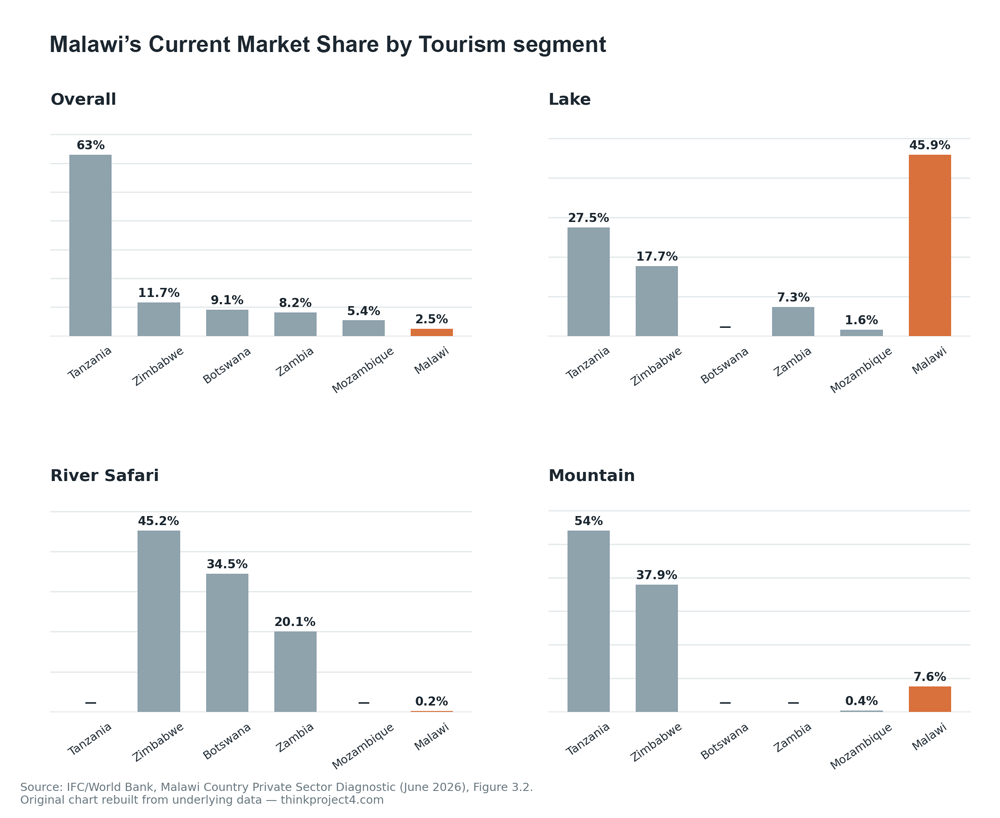
For comparison, the average spend per arrival for South Africa is $838, Zambia is $781, Rwanda is $312, and Mozambique is $258. In terms of market share in the region, Malawi is only able to capture 2.5%. Tanzania holds 63% while Zimbabwe holds an 11.7% share.
This lack of “spend-capture” is driven by a failure to attract high-end investors who require pristine environments. Without a shift toward higher-value offerings, Malawi risks a “race to the bottom,” where low-impact, low-revenue tourism fails to provide the fiscal returns necessary to sustain the very natural assets upon which the industry depends.
The Access Barrier: High Costs and Border Thickness
For a landlocked economy, connectivity is synonymous with competitiveness. Malawi currently faces significant “Border Thickness”—the cumulative economic weight of high travel costs and restrictive regulatory requirements. This thickness acts as a de facto tax on international arrivals, pushing price-sensitive high-value tourists toward more accessible regional clusters.
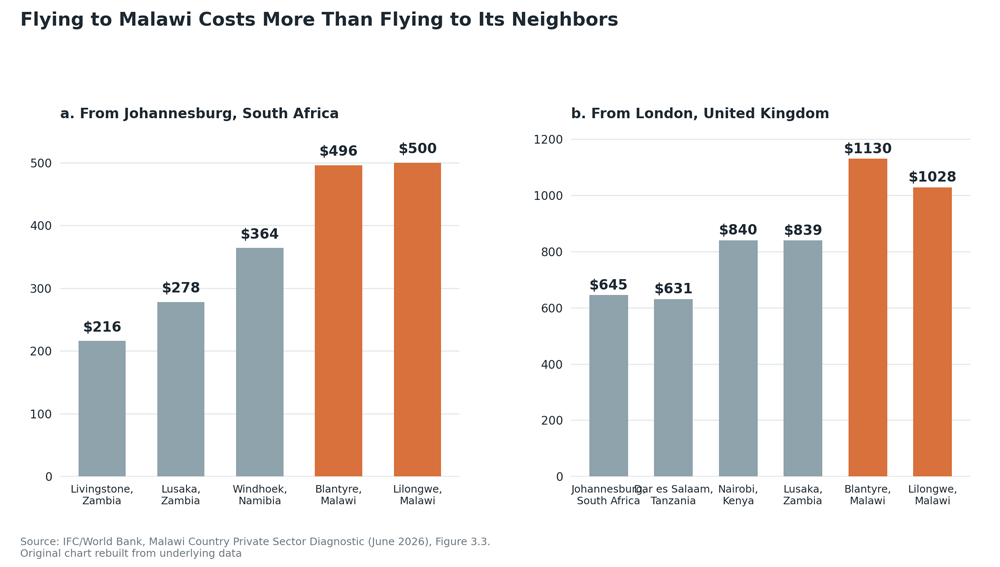
Flight Costs and Connectivity: The cost of entry is prohibitively high. A flight from Johannesburg to Lilongwe (US$500) or Blantyre (US$496) is significantly more expensive than a flight to Livingstone, Zambia (US$364). This disparity is a direct result of Malawi’s non-compliance with the Single African Air Transport Market (SAATM). By restricting “fifth-freedom rights” and maintaining rigid bilateral air service agreements, Malawi limits competition, resulting in fewer connections and artificially inflated ticket prices.
Visa Policy and Entry Requirements: While regional competitors like Botswana, South Africa, and Zambia have moved toward streamlined or visa-free access, Malawi continues to levy reciprocal fees ranging from US50 to US250. These front-end costs create an immediate psychological and financial barrier for travellers comparing multi-destination itineraries in Southern Africa.
Product Imbalance: From Lake Dominance to River Safari Potential
Diversification of the tourism product is essential to increase stay duration and investor appeal. Malawi’s current offering is heavily unbalanced, focused almost exclusively on the lake segment while neglecting the high-value safari market.
Lake Dominance: Malawi accounts for 45.9% of the regional lake tourism segment.
River Safari Underdevelopment: Malawi captures a negligible 0.2% share of the river safari market, a sharp contrast to Zimbabwe (45.2%) and Botswana (34.5%).
The strategic failure here is rooted in uncoordinated licensing and a lack of spatial planning. High-end “quiet retreat” investors require legal and environmental certainty. Under the current fragmented framework, an investor has no assurance that a noisy nightclub won’t be permitted to open adjacent to a luxury lodge. This lack of coherence destroys the commercial viability of prime sites, deterring the globally connected operators necessary to elevate Malawi’s market position.
Operational Friction: Logistics, Infrastructure, and the Skills Gap
Internal logistics and a weak enabling environment create a “friction” that increases operating costs for firms and reduces visitor satisfaction.
Infrastructure and Logistics: 90% of Malawi’s freight is road-based, yet 40% of the road network is in poor condition. Logistics costs account for 55% of total costs for Malawian firms, nearly triple the 20% average for regional landlocked peers. Poor road maintenance means a 3-hour journey frequently takes 5 hours, a problem compounded by frequent, uncoordinated police stops that deter repeat visits.
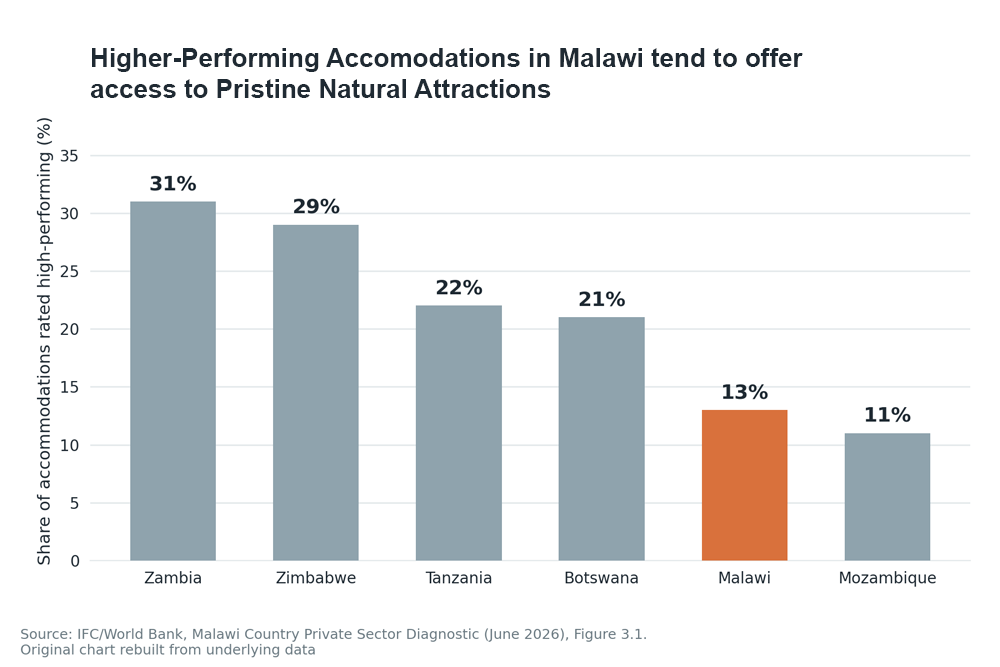
Accommodation Performance: Only 13% of Malawi’s accommodations are “high-performing,” trailing far behind Zambia (31%) and Zimbabwe (29%). This reflects a quality-control crisis that prevents the capture of premium global demand.
The Skills Deficit as a De Facto Tax: With a tertiary enrollment rate of only 3%—far below the 9% Sub-Saharan African average—firms are forced to fill the gap. 42% of Malawian tourism firms conduct extensive in-house training, compared to 28% regionally. This places a significant financial burden on operators, acting as a de facto tax on growth and service delivery.
A Roadmap to US$100 Million
The economic stakes are significant: successful reform could attract US$100 million in private investment, generate 60,000 jobs, and deliver over US$100 million in annual tourism receipts. Malawi possesses the comparative advantage in natural capital; it now requires the institutional framework to convert that advantage into a competitive market position.
To bridge these gaps, the following policy actions from the Malawi Tourism Act 2025 and the Malawi National Tourism Investment Masterplan must be prioritised:
- Air Market Liberalisation: Full implementation of SAATM and the granting of fifth-freedom rights to increase flight frequency and lower costs.
- Infrastructure Certification: Prioritising the ICAO certification of Lilongwe and Blantyre airports to meet international safety and security standards for global carriers.
- Logistics Modernisation: Prioritising upgrades to the M5 and M1 highways and streamlining police checkpoints through transparent, designated corridors.
- Strategic Concessions: Offering transparent, long-term concessions for high-potential sites to attract globally connected operators and protecting these sites through a robust spatial planning framework.
By moving beyond the “hidden gem” narrative and addressing these structural bottlenecks, Malawi can finally position itself as a premier, high-value destination in Southern Africa.